In 30 Seconds
Not every suburb is a hotspot for every investor. This fundamental truth underpins successful property investment, yet it’s frequently overlooked. Your financial circumstances, investment objectives, asset holding timeframe, and budget create a unique investment profile that demands a tailored approach to suburb selection.
HTAG’s Goal Matching feature eliminates the guesswork by using predictive analytics and comprehensive property data to surface only the markets that align precisely with your brief.
Why Constructing Your Investment Brief Is the Most Critical Step
Before diving into suburb research or scrolling through endless listings, successful investors understand that defining their investment criteria is paramount. The cost of investing in an allocation that underperforms relative to other locations—what property professionals call opportunity cost—can amount to hundreds of thousands of dollars over a portfolio’s lifetime.
Every investor faces different circumstances. A buyer with an $850,000 budget operates in entirely different markets than someone with $550,000 to invest. The areas that generate exceptional returns for one investor may be completely inaccessible or unsuitable for another. This is precisely why a one-size-fits-all hotspot list fails most investors—and why data-driven insights through goal matching are essential for eliminating opportunity cost.
How HTAG’s Goal Matching Works
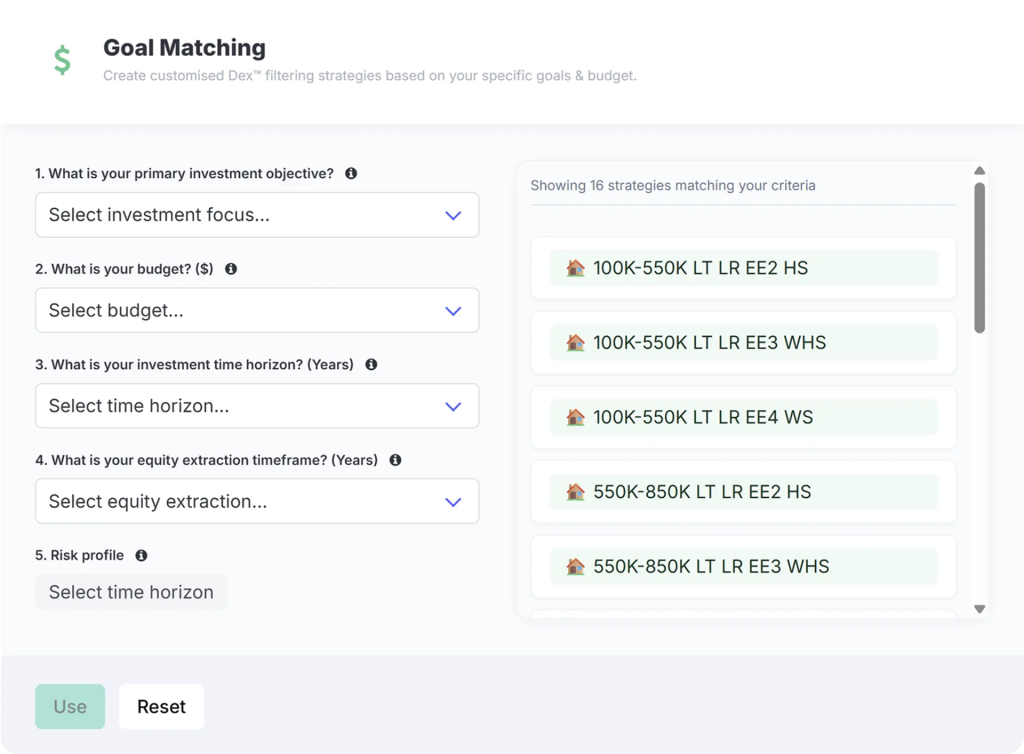
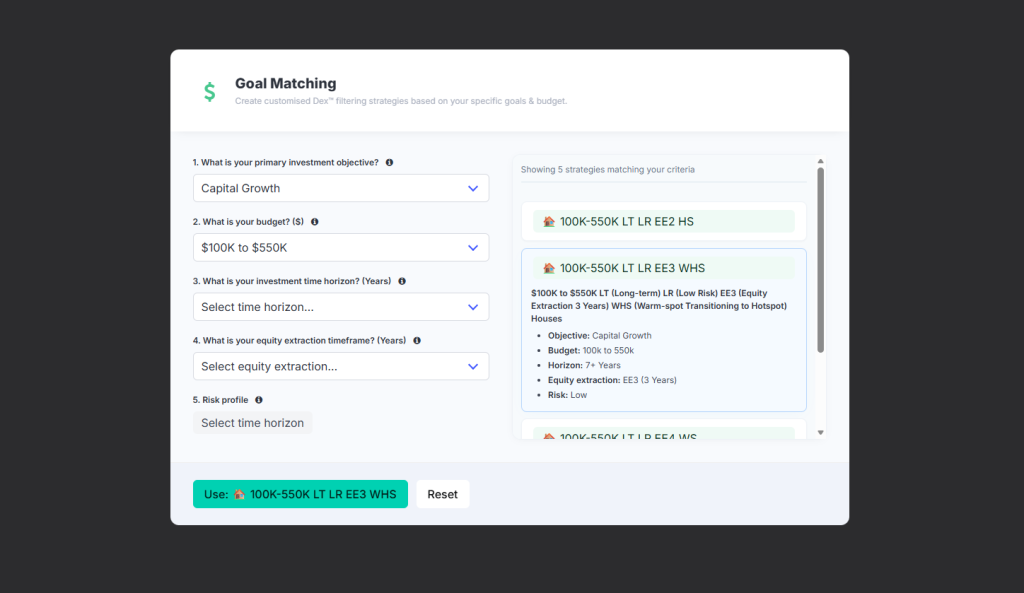
HTAG’s Goal Matching tool presents 16 distinct investment strategies that compress dynamically as you answer key questions about your investment profile. Each answer refines the algorithm, narrowing down to the strategy that matches your unique circumstances and priorities.
Step 1: Define Your Primary Investment Objective
The first critical decision is determining whether you’re pursuing capital growth or cashflow. While balanced strategies exist, property markets move through cycles—some periods favour capital appreciation while others see stronger rental demand.
Capital growth strategies focus on expanding your equity base to leverage into additional purchases. Research demonstrates that the opportunity cost of prioritising cashflow over growth can exceed $1.1 million in wealth over 30 years, as capital appreciation compounds exponentially while rental income grows linearly. However, cashflow strategies suit investors requiring immediate passive income or those building serviceability for future lending.
Understanding this distinction is essential for property investors making informed property decisions.
Step 2: Establish Your Budget Parameters
HTAG segments budgets into strategic ranges—$100K to $550K, $550K to $850K, and $850K plus—because each price bracket produces different sets of property investment indicators and metrics. These aren’t arbitrary divisions; they reflect how different price segments interact with market fundamentals and affect the precision of suburb recommendations.
Within these ranges, investors can fine-tune their budget. If your maximum is $750,000, you might set the range from $550K to $750K. Keeping approximately $200,000 of variance casts a wider net and increases potential options while maintaining strategic focus.
Step 3: Determine Your Asset Holding Timeframe
How long you intend to hold the property significantly influences which suburbs will perform best for your strategy:
- Short-term (1-3 years): Suited for investors planning to leverage rapid growth, capture gains, absorb acquisition costs, and use proceeds to acquire larger assets. These strategies require markets already exhibiting strong momentum.
- Medium-term (4-6 years): Ideal for investors who want to generate equity, potentially sell, and use returns for goals such as paying down their principal place of residence.
- Long-term (7+ years): Designed for investors planning to refinance multiple times, leveraging growth repeatedly to fund additional purchases and build a substantial portfolio.
Each timeframe prioritises different predictive analytics indicators. Short-term holds require markets with immediate growth signals, while long-term strategies can accommodate earlier market entry and longer appreciation curves.
Step 4: Set Your Equity Extraction Timeframe
This final parameter defines your growth targets and market heat preferences:
- Two-year equity extraction: Targets 20%+ returns within two years to leverage quickly into additional assets. This approach requires investing in current hotspots—markets already experiencing significant momentum with high competition.
- Three-year equity extraction: Focuses on transitioning markets—suburbs moving from warm spots to hotspots. These areas have typically generated around 5% growth recently and show building momentum, making asset sourcing easier while still delivering strong medium-term returns.
- Four-year equity extraction: Anticipates market movements by entering early. While requiring patience for momentum to build, this approach offers significant advantages: minimal competition for listings, below-market entry prices, and the opportunity to capture the entire growth cycle.
The Science Behind Strategy Matching
As you answer each question, HTAG’s algorithms dynamically compress the available strategies. From 16 initial options, each response eliminates strategies that don’t align with your criteria until you’re matched with a single, optimal approach.
This matching process isn’t arbitrary. Each strategy informs a specific set of property investment metrics and indicators that the research algorithm prioritises. These metrics are calibrated to your:
- Budget constraints and borrowing capacity
- Investment timeline and growth expectations
- Risk tolerance and market entry preferences
- Equity extraction goals and portfolio building speed
The result is a filtered universe of suburbs where the fundamental indicators—rental yield, vacancy rates, sales data, building approvals, and growth trajectories—align with your strategic requirements.
Find Your Perfect Property Strategy
Stop scrolling through irrelevant listings. Let data refine your search from 7,000+ suburbs down to the specific markets that fit your budget and growth targets.
From Matching to Market: The Research Algorithm
Once matched to a strategy, HTAG’s research algorithm takes over. Rather than presenting thousands of suburbs with no context, the algorithm surfaces only markets meeting your investment parameters. Every suburb is evaluated against your criteria using comprehensive property data and market insights.
This approach transforms suburb selection from an overwhelming, time-consuming process into a focused shortlisting exercise. Instead of spending countless hours filtering irrelevant listings, investors receive a curated set of opportunities with the highest probability of meeting their objectives.
Why Goal Matching Is Essential for Smart Property Decisions
The property investment landscape in Australia spans roughly 15,000 suburbs and localities, of which around 7,000+ transact often enough to be analysed honestly — each with unique characteristics, growth drivers, and risk profiles. Without a systematic framework for filtering this universe, investors face several common pitfalls:
- Analysis paralysis: Too many options without clear evaluation criteria leads to indecision or poor choices based on superficial factors.
- Emotional decision-making: Without defined parameters, investors chase media-hyped hotspots or purchase based on familiarity rather than fundamentals.
- Misaligned timing: Entering markets too late—after growth has peaked—or too early without the holding capacity to wait for appreciation.
- Opportunity cost: The hidden cost of selecting a lower-performing suburb over available alternatives with stronger fundamentals.
Goal Matching addresses each of these challenges by grounding every decision in data analytics and predictive models tailored to individual circumstances.
Building Confidence Through Data Validation
Property investment represents significant capital deployment, and confidence in decisions comes from validation against objective criteria. HTAG’s Goal Matching provides this validation by:
- Aligning financial capacity with market opportunities to ensure realistic, achievable targets
- Calibrating expectations to timeframes so growth projections match holding periods
- Filtering for risk-appropriate markets based on budget and experience level
- Eliminating emotional bias through systematic, data-driven filtering
This approach reflects how sophisticated property professionals and buyers agents construct briefs for their clients—translating broad objectives into specific, measurable investment criteria that guide every decision.
Your Investment Brief Is Your Competitive Advantage
In competitive markets, investors who know exactly what they’re looking for—and why—hold significant advantages. They can act decisively when opportunities emerge, avoid overpaying for misaligned assets, and build portfolios systematically rather than opportunistically.
HTAG’s Goal Matching transforms abstract investment goals into concrete, actionable briefs. Whether you’re a first-time property investor or expanding an existing portfolio, starting with a clear strategy aligned to your circumstances is the foundation of success.