In 30 Seconds
ChatGPT can describe how to research a suburb, but on its own it cannot price one. Using live HtAG house data as at 30 June 2026, this article measures the gap between what a frozen AI model believes and what the market is actually doing — including one Brisbane suburb that moved $151,655 in twelve months — and shows how to close that gap by grounding your AI agent in live data.
Ask ChatGPT to name the best suburb for your budget and it will answer instantly, fluently and with total confidence. That is exactly the problem. The answer is assembled from a training snapshot that stopped learning months or years ago, blended from every forum post and headline the model has ever read — and it carries no as-at date.
The nutshell answer: No — ChatGPT and other generic AI models cannot reliably pick investment suburbs on their own, because they price from a frozen snapshot of the past. On HtAG house data, Zillmere (QLD) rose $151,655 in the year to 30 June 2026 — drift a knowledge-cutoff model simply cannot see. Grounded in live data, however, the same AI becomes a genuinely powerful research analyst.
In 30 seconds
What is it? A live-data test of what generic AI models like ChatGPT get wrong when asked to pick or price Australian investment suburbs.
Why does it matter? AI answers sound authoritative but are typically six to eighteen months out of date — in markets that moved 11–15% over the past year, that is a six-figure error.
Who uses it? Investors and buyers’ agents who already research with ChatGPT, Claude or Perplexity and want answers they can act on.
Use it on its own? No. Use AI for synthesis and workflow, and connect it to live property intelligence for every number.
Table of Contents
- Can ChatGPT pick investment suburbs?
- The knowledge-cutoff problem: priced for a market that no longer exists
- Three more ways generic AI gets suburbs wrong
- What AI is genuinely good at
- The fix: ground the AI in live data
- Surface this data inside your AI agent
- Key takeaways
- From data signal to portfolio decision
- Frequently asked questions
Can ChatGPT pick investment suburbs?
Not on its own. A large language model without live data answers property questions from its training snapshot — a compressed memory of the internet that stops at a fixed cutoff date. It has no feed of current prices, rents, listings or sales volumes, so every dollar figure it quotes is a recollection, not a reading.
Web browsing does not close the gap either. When ChatGPT searches the web, it retrieves portal headlines and city-wide medians – not a composition-controlled, suburb-level price series with an as-at date – and it still blends what it finds with its stale training priors. Grounded, structured data is a different architecture from a model quoting search snippets, which is exactly the distinction this article measures.
This is not hypothetical – HtAG has measured it. In the Salisbury North case study, a generic AI recommended the suburb off three surface metrics; the full-data read scored it just 21/100 on the Relative Composite Score, with elevated risk and fading momentum.
That distinction is invisible in the answer itself. Generic AI does not flag which of its claims are stale; it presents a 2024 price and a 2026 price with the same fluent confidence. According to HtAG Analytics, this is the single most common failure mode we see when investors bring AI-generated shortlists to the platform: the reasoning is often sensible, but the numbers underneath it describe a market that no longer exists.
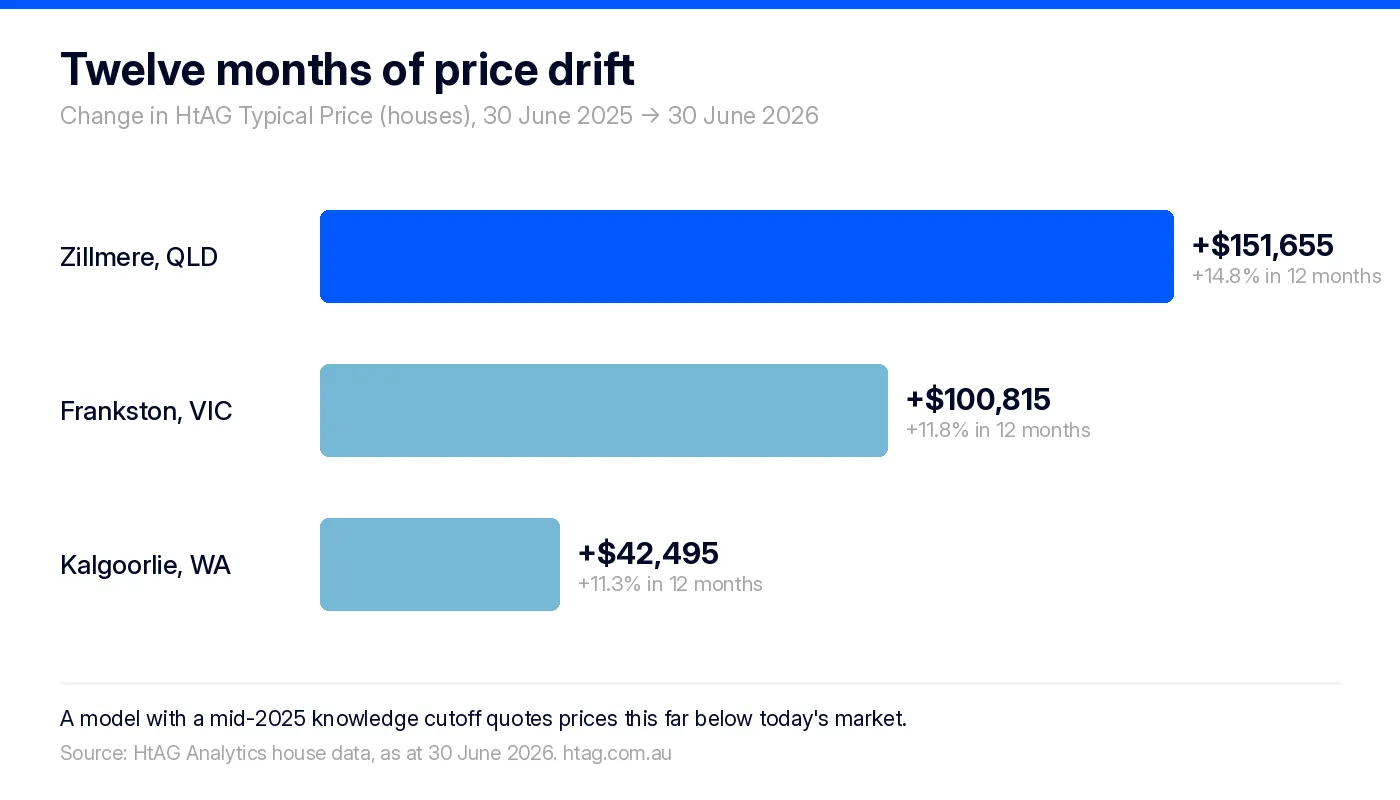
According to HtAG Analytics house data, the Typical Price of Zillmere (QLD) rose from $1,023,901 to $1,175,556 in the twelve months to 30 June 2026 — a $151,655 move that sits entirely outside a mid-2025 knowledge cutoff.
None of this means AI is useless for property research — the opposite. HtAG’s guide to AI property investment research in Australia sets out the full workflow. But the workflow only produces decisions you can act on when the AI is connected to live data. This article quantifies why.
The knowledge-cutoff problem: priced for a market that no longer exists
A knowledge cutoff is the date a model’s training data ends; most mainstream AI models answer from a snapshot six to eighteen months behind the day you ask. To measure what that staleness costs, we pulled the live monthly Typical Price series for three Australian house markets — one metro, one regional lifestyle, one mining-services — and measured the drift a frozen model cannot see.
| Suburb | Typical Price, Jun 2025 | Typical Price, Jun 2026 | 12-month drift | Drift since Jun 2024 |
|---|---|---|---|---|
| Zillmere, QLD | $1,023,901 | $1,175,556 | +$151,655 (+14.8%) | +$293,783 (+33.3%) |
| Frankston, VIC | $857,720 | $958,535 | +$100,815 (+11.8%) | +$140,313 (+17.1%) |
| Kalgoorlie, WA | $375,211 | $417,706 | +$42,495 (+11.3%) | +$82,051 (+24.4%) |
Source: HtAG Analytics house data, monthly Typical Price series, as at 30 June 2026. All three markets carry a High data-confidence rating. Typical Price is HtAG’s robust central price — a more stable measure than the median.
What This Means in Plain English
If the AI you’re asking last “saw” the market in mid-2025, every price it quotes for these suburbs is roughly a year’s growth short — between $42,000 and $152,000 light. You would set your budget, judge value and negotiate off numbers the market left behind.

Three more ways generic AI gets suburbs wrong
Stale prices are the most measurable failure, but they are not the only one. Three further failure modes show up consistently when generic AI is asked to do a suburb analyst’s job.
1. It averages every opinion it has ever read
A language model’s “view” of a suburb is a blend of old news articles, forum threads and marketing copy — weighted by volume, not accuracy. Suburbs with loud reputations get described by their reputation, not their fundamentals. HtAG’s spatial research found exactly this trap in the data: in one Brisbane postcode, the best-known “premium” name was the weakest performer of six adjacent suburbs on realised five-year growth. An AI trained on commentary inherits the reputation, not the result.
2. It cannot see the cycle turning
Momentum reads brilliantly in a training snapshot and reverses badly in real life. Zillmere is the live example: its five-year growth has compounded at 13.7% a year on HtAG data, which is precisely what a model trained on recent commentary would celebrate. The live reading is more sober — as at 30 June 2026 HtAG’s Growth Rate Cycle places Zillmere in a decelerating phase, with the market running well above its own long-run pace. A frozen model recommends yesterday’s boom; live data shows the boom cooling.
3. It quotes numbers that were never true
When a model has thin coverage of a smaller market, it does not say so — it interpolates. Plausible-sounding medians, yields and vacancy rates get generated to fill the gap, with no source and no as-at date. This is why data without provenance isn’t enough: a number you cannot trace is a number you cannot act on. HtAG’s free whitepaper on the danger of AI-generated property advice documents these failure modes in detail.
What This Means in Plain English
Think of generic AI as a well-read friend who moved overseas a year ago: great at explaining concepts, full of opinions about suburbs — but the prices in their head are from the day they left, and they’d rather guess than admit a gap.
What AI is genuinely good at
AI is exceptional at the parts of suburb research that drown human analysts: synthesising many metrics at once, explaining what a metric means in plain English, comparing markets side by side, and turning a goal (“cashflow first, moderate risk, under $700k”) into a structured brief. What it lacks is not intelligence — it is current, sourced, decision-grade inputs.
That is the division of labour behind AI-Native Property Intelligence: the AI reasons, and a live data layer supplies every number with a source and an as-at date. The same logic applies to human experts — HtAG’s view has long been that AI narrows the gap between amateurs and professionals without replacing judgement, because the final 20% of conviction still comes from verification and context.
The fix: ground the AI in live data
The fix is architectural, not behavioural: connect the model to a live data source so it stops recalling and starts querying. Through MCP — the Model Context Protocol — an AI agent can call HtAG’s live endpoints the moment you ask a question, covering 7,000+ suburbs and all 537 LGAs, updated quarterly, through 104+ endpoints.
The difference is easiest to see in a worked example. Asked about Frankston (VIC), a grounded agent doesn’t reminisce — it pulls the live read: Typical Price $958,535, gross yield 3.12%, and a Relative Composite Score of 85 (Lower Risk 97, Cashflow 95, Capital Growth 63), all stamped 30 June 2026 with a High confidence rating. Every figure has a source, a date and a definition — and next quarter, the same question returns next quarter’s answer.
A generic AI recalls; a grounded AI queries. On HtAG data as at 30 June 2026, that is the difference between pricing Frankston at memory and reading RCS 85 on a Typical Price of $958,535 — with the date attached.

Setting this up takes minutes, not a development team. The step-by-step guide to adding live Australian property data to ChatGPT, Claude and Perplexity walks through it, and the underlying Australian property data API serves developers building deeper workflows. It is the same live layer that powers Property Intelligence across the HtAG platform itself.
What This Means in Plain English
You don’t have to choose between “AI convenience” and “numbers I can trust”. Connect your AI to a live feed once, and every answer it gives you afterwards is built from today’s market — not its memory of last year’s.
ChatGPT is only one option — we compare ChatGPT, Claude, Perplexity and Gemini in our guide to the best AI assistant for Australian property research.
Surface this data inside your AI agent
The HtAG Developer Portal exposes the data described in this article — and every other HtAG dataset — through MCP (Model Context Protocol) connectors. Investors and buyers’ agents using Claude, Perplexity, Manus AI, ChatGPT (via custom connectors) or any other MCP-compatible AI agent can query HtAG data directly inside the AI tool they already use — turning the generic AI described above into a grounded one.
HtAG’s MCP-enabled Developer Portal puts every metric in this article inside your AI agent. Apply for access and run live suburb reads on any Australian market without leaving Claude or Perplexity.
HtAG Analytics Developer Portal (2026)
Browse the endpoint catalogue at developer.htagai.com and submit the HtAG Developer Portal application — approved members receive an API key and an MCP setup guide for their preferred AI tool.
A general model can summarise. It cannot run a method. This is what a real research workflow looks like, from client brief to vetted listing.
Key takeaways
- ChatGPT and other generic AI models cannot reliably pick or price investment suburbs on their own — they answer from a frozen training snapshot with no as-at date.
- On HtAG house data, twelve months of drift to 30 June 2026 reached +$151,655 in Zillmere (QLD), +$100,815 in Frankston (VIC) and +$42,495 in Kalgoorlie (WA) — the gap a mid-2025 knowledge cutoff cannot see.
- Beyond stale prices, generic AI averages reputations instead of reading fundamentals, misses cycle turns, and interpolates numbers it never had.
- AI is excellent at synthesis, explanation and workflow — the failure is in its inputs, not its reasoning.
- Grounding the same AI in live HtAG data via MCP gives every answer a source, a date and a definition — 7,000+ suburbs, all 537 LGAs, updated quarterly.
Cite this analysis
HtAG Analytics (2026). Can ChatGPT Pick Investment Suburbs? What Generic AI Misses. House-market Typical Price drift measured over the 12 and 24 months to 30 June 2026 across Zillmere (QLD), Frankston (VIC) and Kalgoorlie (WA). Published 10 July 2026. https://www.htag.com.au/can-chatgpt-pick-investment-suburbs/
From data signal to portfolio decision
The Typical Price, Relative Composite Score and market-cycle reads used in this article are live inside the HtAG Analytics platform — updated each quarter as new valuation data flows in. Investors and buyers’ agents use them to replace recalled numbers with current ones across every market they consider, before they make an offer.
If you research with AI and want the numbers underneath to be real, the HtAG Starter Plan gives you suburb-level analytics across every Australian market — no lock-in, cancel any time.
Start your HtAG Analytics membership → · Apply for Developer Portal access →
Frequently asked questions
Can I use ChatGPT for property investment research in Australia?
Yes — for synthesis, explanation and structuring your research, ChatGPT is genuinely useful. What it cannot do on its own is supply current numbers: its answers come from a training snapshot, and on HtAG data individual suburbs moved 11–15% in the year to 30 June 2026. Connect it to a live data source before acting on any figure it quotes.
Can ChatGPT build a suburb shortlist on its own?
No. Ranking thousands of Australian markets against an investment brief needs a scored, current dataset, which a disconnected model does not have. Generic AI is useful for structuring your criteria, explaining what a metric means and stress-testing your reasoning — but the shortlist itself has to come from live data. If your question is narrower, and you want to know whether the numbers a chatbot quotes are correct, that is covered in Does AI Give Accurate Australian Property Data?
What is the difference between generic AI and AI-native property intelligence?
Generic AI answers property questions from memory. AI-Native Property Intelligence is property intelligence delivered through machine-readable interfaces (APIs/MCP) so an AI agent can query, reason over and act on live, scored, decision-grade data — every figure carrying a source and an as-at date instead of a guess.
How do I access HtAG suburb data inside Claude or Perplexity?
Apply for the HtAG Developer Portal. Browse the endpoint catalogue at https://developer.htagai.com/ and submit the application form at https://links.htag.com.au/widget/form/GFVegAaXzeTUH7QzRl1T. Approved members receive an API key and an MCP setup guide, so Claude, Perplexity, Manus AI or any MCP-compatible agent can pull live Typical Price, RCS and market-cycle reads for any of 7,000+ Australian suburbs.
Will AI replace buyers agents and property researchers?
No. Grounded AI compresses the research workload dramatically, but the final conviction — verifying on the ground, weighing a client’s circumstances, negotiating — remains human. The professionals winning with AI are the ones supplying it with live, decision-grade data rather than competing against its memory.
Disclaimer
This article is general information only and does not constitute financial, investment or property advice. All figures are drawn from HtAG Analytics house data as at 30 June 2026 and are subject to change; past performance and cycle position are not guarantees of future results. Named suburbs are illustrative descriptive findings, not buy recommendations — several are late in their growth cycle. Do your own due diligence and seek licensed professional advice before making any investment decision.
The conceptual framework behind the metrics in this article is published openly for transparency and education. Their proprietary implementation — calibration, weighting, validation and the underlying data — remains the confidential intellectual property of HtAG Analytics.
This article forms part of the HtAG Property Intelligence Reference Library — a structured knowledge base documenting the concepts, metrics and methodologies used to analyse Australian residential property markets.
Reference Standard PI-AIRESEARCH · Version 1.0